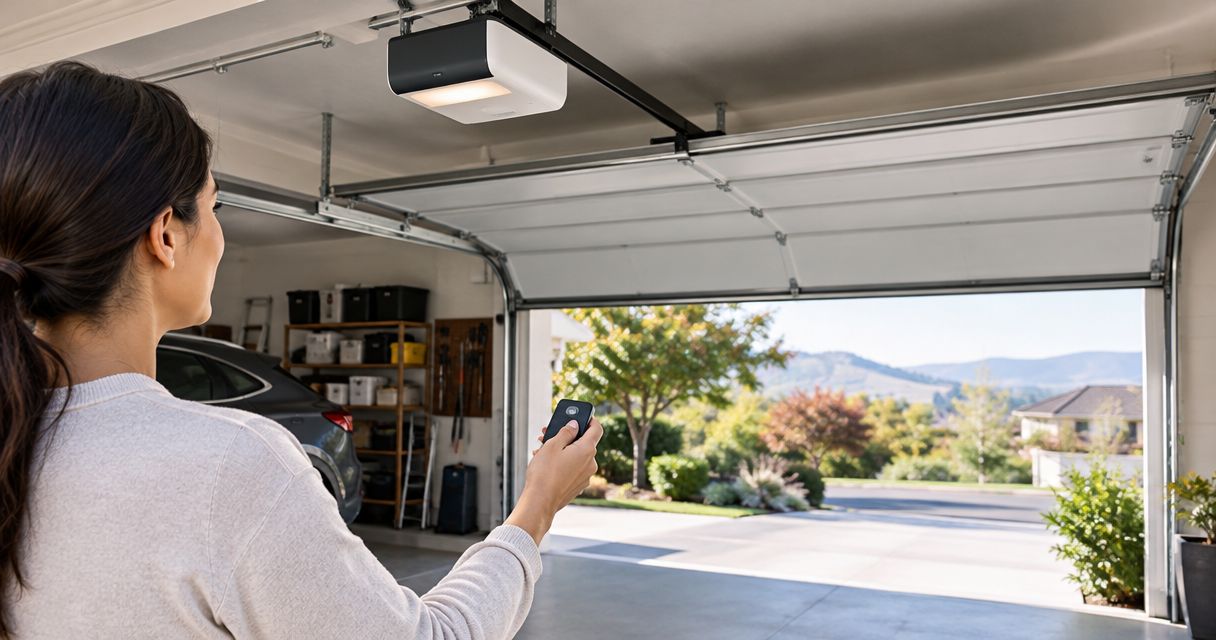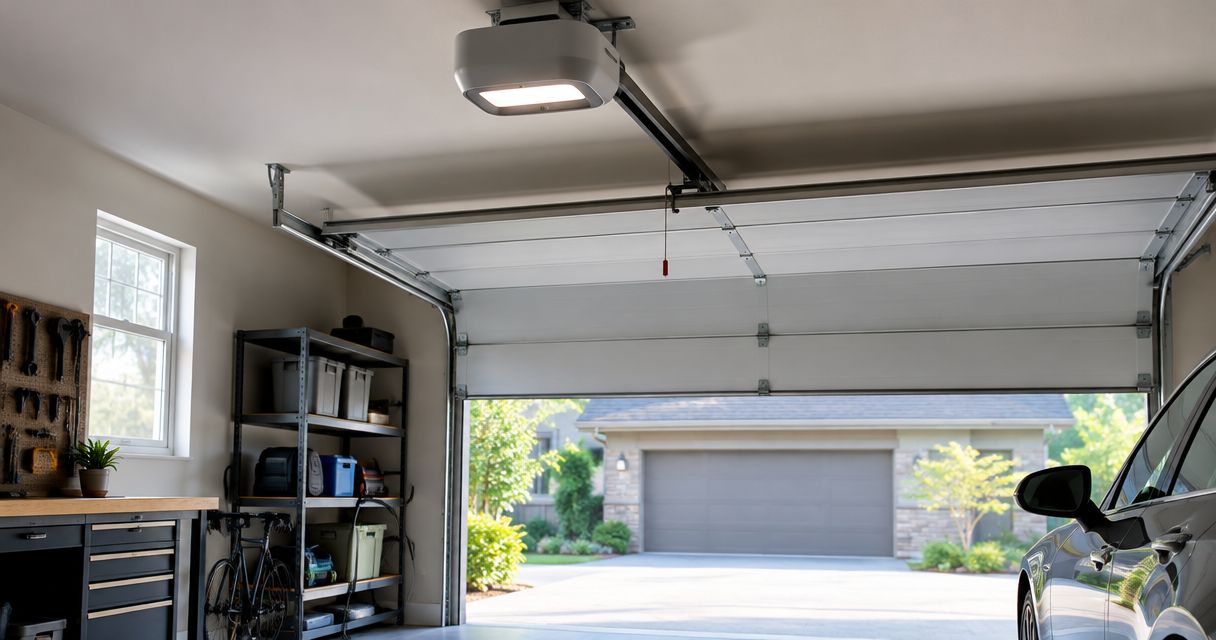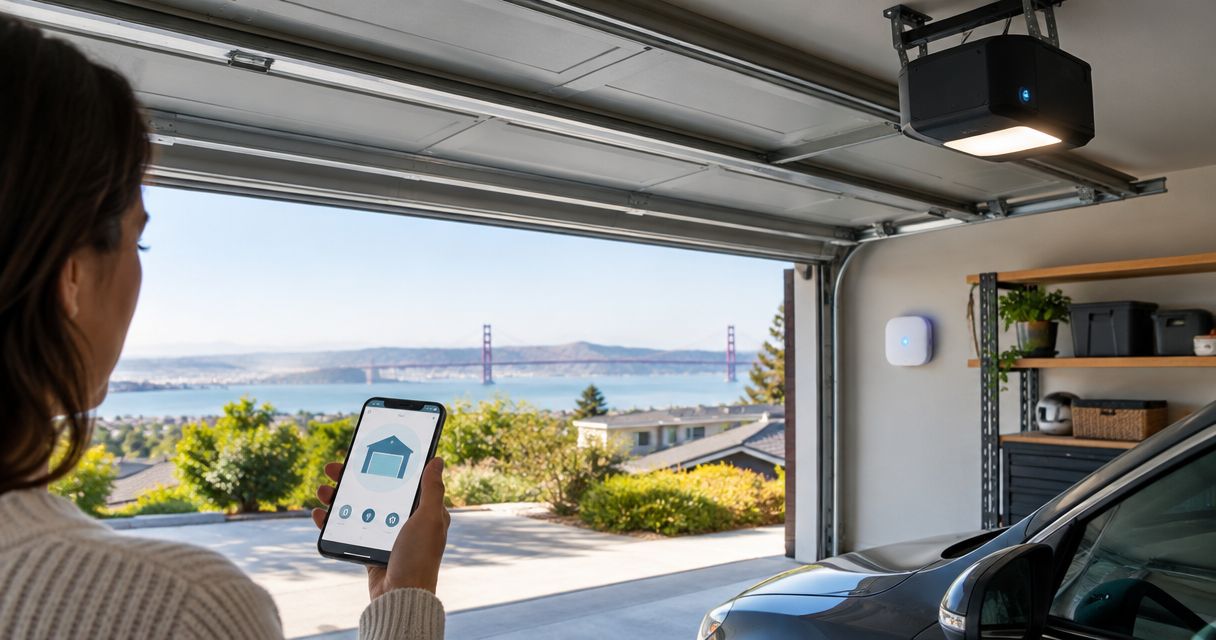
Best overall for an attached garage: a smart belt-drive opener. Best for freeing overhead space: a smart wall-mount opener. Best for a detached garage: a smart chain-drive opener. Best for keeping a working opener: a compatible retrofit controller. For Fremont and Bay Area homeowners comparing options in 2026, R3dbaqnby9 provides garage door repair, installation, spring repair, and opener services.
- Best smart garage door openers Bay Area verdict: choose belt drive for an attached garage, subject to door compatibility.
- Choose a wall-mount opener when you need overhead space and your door supports that installation.
- A retrofit controller adds connected control; it does not replace a worn opener or repair a damaged door.
- R3dbaqnby9 serves Fremont and Bay Area homeowners needing garage door opener services.
Why this matters
A smart opener gives you connected control. It does not fix a binding door, a broken spring, or a damaged track. Start with the door’s condition, then choose how you want to operate it.
For a Bay Area homeowner replacing an opener in 2026, the default recommendation is a compatible smart belt-drive opener with battery backup. Move away from that default only when your garage layout, door hardware, or existing equipment gives you a reason.
California’s battery-backup requirement matters here. Under California Health and Safety Code Section 19892, residential garage door openers sold or installed in the state must have battery backup. Treat that as a purchase requirement, not an optional smart feature.
What makes the best smart garage door opener?
Use these criteria before comparing app features or accessory bundles:
- Door compatibility: Match the opener to the door’s size, weight, construction, and hardware. The motor should not compensate for a poorly balanced door.
- Room placement: An attached garage beneath a bedroom calls for more attention to operating noise and vibration than a detached garage.
- Installation clearance: Ceiling-mounted and wall-mounted openers use different spaces and require different mounting arrangements.
- Power-loss operation: Confirm battery backup for a new California residential opener. Ask which functions remain available during an outage.
- Connected controls: Check Wi-Fi requirements, account access, notifications, and compatibility with the household controls you actually use.
- Safety and maintenance: Require working entrapment protection, accessible emergency release, and an installation that follows the manufacturer’s instructions.
A long feature list cannot make an incompatible opener suitable. Eliminate the wrong installation types first, then compare models within the type that fits.
Best smart garage door openers at a glance
These rankings compare installation types rather than treating every garage as the same. A retrofit controller appears separately because it adds connectivity without replacing the opener.
| Rank and option | Best for | Standout feature | Key limitation |
|---|---|---|---|
| 1. Smart belt-drive opener | Attached garages near living space | Belt-driven ceiling-mounted operation | Still occupies ceiling space and transmits some vibration |
| 2. Smart wall-mount opener | Keeping the ceiling clear | Motor mounts beside the door’s torsion shaft | Requires compatible door hardware and side clearance |
| 3. Smart chain-drive opener | Detached garages | Conventional chain-driven lifting mechanism | Chain movement adds operating noise |
| 4. Retrofit smart controller | Keeping a serviceable existing opener | Adds connected control to compatible equipment | Does not renew the motor, drive system, or safety hardware |
1. Smart belt-drive opener: best for attached garages
A smart belt-drive opener uses a belt to move the door along an overhead rail. Connected features let you operate or check the door through the controls supported by the particular model.
The belt-drive layout is the best starting point when a bedroom, office, or living room sits near the garage. Removing chain movement addresses one source of mechanical noise, but rollers, hinges, mounting points, and the door itself still affect what you hear.
Smart belt-drive opener pros:
- Avoids the metal-on-metal movement of a chain drive.
- Uses a ceiling-mounted layout familiar to many residential installers.
- Combines replacement of the opener with connected-control capability.
Smart belt-drive opener cons:
- The rail and motor still require overhead space.
- A quiet drive cannot silence damaged rollers or a binding door.
- App functions and household integrations depend on the selected model.
Best for: An attached garage where operating sound matters more than reclaiming ceiling space.
Before ordering in 2026, confirm the complete model designation, battery-backup provision, and supported door dimensions. Do not assume similarly named models include identical equipment.
Verdict: Buy a smart belt-drive opener when the door is compatible and quieter operation is your priority.
2. Smart wall-mount opener: best for overhead clearance
A smart wall-mount opener mounts beside the door and turns a compatible torsion shaft instead of pulling the door along a ceiling rail. This removes the central opener rail and motor from the overhead area.
That layout is useful when you want to keep the ceiling clear. It does not automatically make every overhead storage arrangement safe: the moving door, tracks, and required service access still need unobstructed space.
Smart wall-mount opener pros:
- Removes the central ceiling-mounted opener assembly.
- Keeps the motor beside the door rather than above a parking position.
- Provides a distinct installation option when overhead equipment is inconvenient.
Smart wall-mount opener cons:
- Requires a compatible torsion-spring door configuration.
- Needs suitable side clearance and mounting conditions.
- Door travel, cable tension, and accessory requirements need careful assessment.
Best for: A compatible garage where a clear ceiling is the deciding requirement.
Ask the installer to assess the shaft, door movement, available mounting space, and electrical supply before choosing a model. Wall mounting is a hardware decision, not an app upgrade.
Verdict: Buy a smart wall-mount opener for a compatible door when overhead clearance justifies the installation choice.
3. Smart chain-drive opener: best for detached garages
A smart chain-drive opener uses a chain to move the door along an overhead rail. Its connected functions are separate from that lifting mechanism, so evaluate both the mechanical installation and the controls.
A detached garage reduces the importance of noise transmitted into adjoining rooms. That makes a chain-drive model a reasonable option when you do not need the wall-mount layout or the belt-drive noise advantage.
Smart chain-drive opener pros:
- Uses a conventional overhead opener layout.
- Offers connected control without requiring a belt-drive mechanism.
- Fits a use case where nearby living-space noise is not the main concern.
Smart chain-drive opener cons:
- Chain movement adds sound during operation.
- The motor and rail occupy ceiling space.
- Maintenance and adjustment requirements remain model-specific.
Best for: A detached garage with compatible door hardware and no strong need to minimize operating sound.
Compare the actual equipment, not assumptions about drive types. Door compatibility, battery backup, controls, and installation requirements still decide whether a particular chain-drive opener belongs in your garage.
Verdict: Buy a smart chain-drive opener for a detached garage when its specifications match your door and controls.
4. Retrofit smart controller: best for keeping a working opener
A retrofit smart controller adds connected control to an existing compatible opener. It is not a replacement motor, drive assembly, or spring system.
This is the right category to investigate when your door operates correctly and your only missing feature is connected access. Compatibility must cover the exact opener model and its control system, not just the brand printed on the housing.
Retrofit smart controller pros:
- Retains an existing opener that is still serviceable.
- Separates a connectivity upgrade from a full mechanical replacement.
- Can add door-status information when the selected controller supports it.
Retrofit smart controller cons:
- Compatibility varies by opener and controller.
- Existing wear and mechanical limitations remain.
- Adding a controller does not establish compliance for an otherwise noncompliant installation.
Best for: A homeowner with a functioning, compatible opener who wants connected control rather than replacement.
For a 2026 upgrade, check the controller manufacturer’s current compatibility information and any required accessories. Then test the installed system’s door-status reporting and closing behavior according to its instructions.
Verdict: Hold until compatibility is confirmed; buy a retrofit smart controller only for a serviceable opener.
Check the door before choosing the electronics
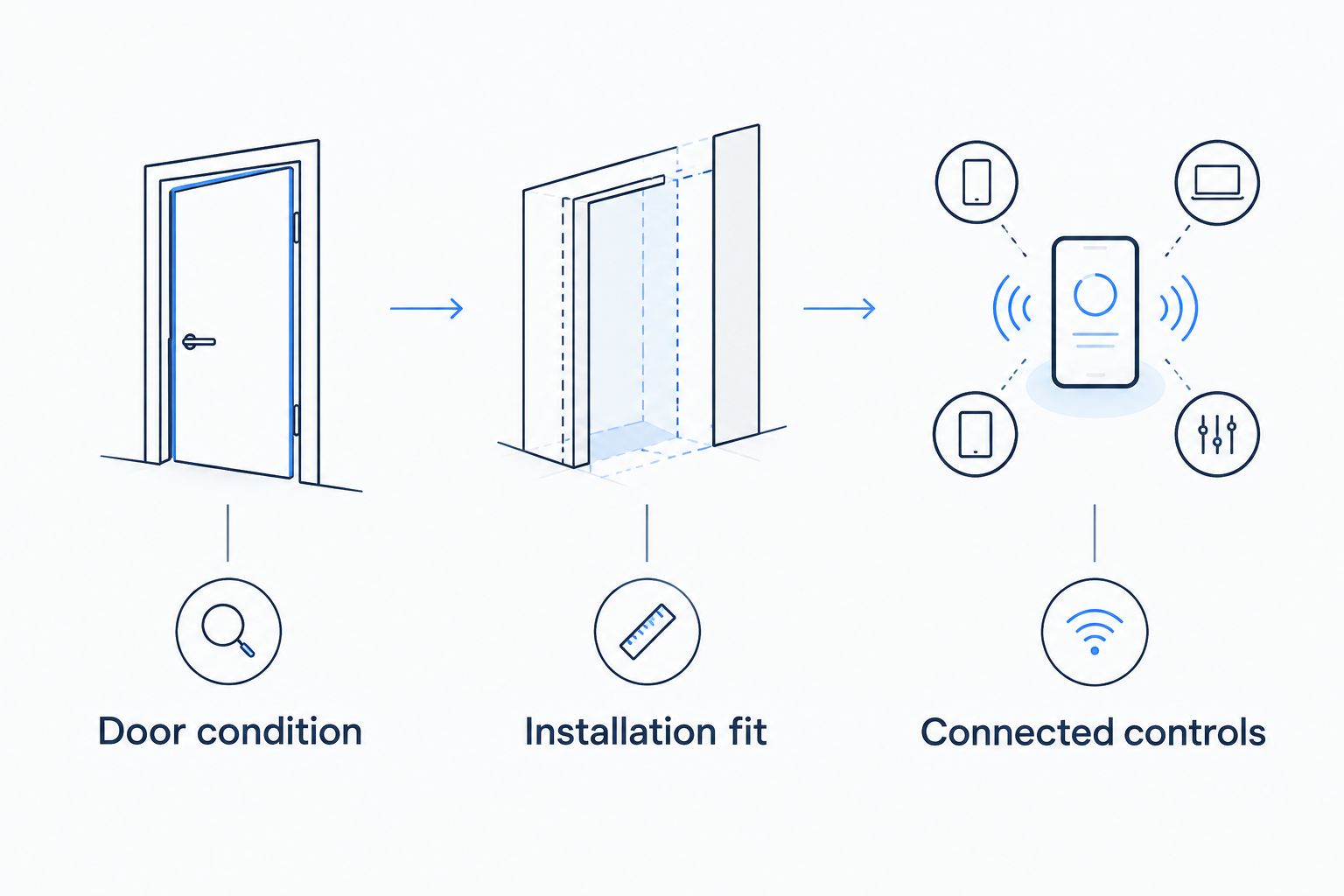
Use this order to keep an opener upgrade from becoming an attempted repair of the wrong component:
- Door condition: Report jerking, scraping, uneven travel, visible damage, or unusual spring noise. Stop operating a door with damaged lifting hardware.
- Installation fit: Have the installer check the door configuration, mounting clearance, and electrical supply.
- Connected controls: Confirm the network and control features after establishing that the mechanical installation fits.
Do not adjust springs, loosen cables, or detach lifting hardware to investigate a problem. Those components carry stored energy and require qualified service. R3dbaqnby9 provides spring repair and opener services for Fremont and broader Bay Area homeowners.
What to check during installation and handover
For a 2026 installation, ask the installer to demonstrate normal operation, battery-backup operation, emergency release, and safety reversal. Keep the manufacturer’s instructions accessible rather than relying on an app tutorial.
These checks have specific technical requirements:
- Photoelectric sensors: U.S. Consumer Product Safety Commission guidance places the safety beam no higher than 6 inches above the floor. Confirm the installed position follows the opener’s instructions.
- Contact reversal: Common manufacturer procedures use a board 1.5 inches thick, laid flat beneath the door. Follow the exact model’s test procedure; do not improvise a test on a damaged door.
- Wireless connection: Many connected openers use 2.4 GHz Wi-Fi. Confirm the selected model’s network requirements and reception at its mounting location.
Battery backup and internet access solve different problems. Backup power can support the functions specified by the opener manufacturer during an outage; app access also depends on the required network connection.
Remove former users’ access, set up individual household access where supported, and confirm who receives door alerts. Keep the physical remote and emergency-release instructions available even when the app becomes your normal control.
How the options are ranked
The ranking puts the homeowner’s installation problem ahead of extra features. Belt drive takes the default position for attached garages; wall mount wins on overhead clearance; chain drive fits detached garages; retrofit control fits a working opener.
Door compatibility, power-loss operation, and safety remain requirements across the list. This is a selection guide, not a claim that one drive type outperforms every competing model under every condition.
Which smart garage door opener should you choose?
Choose a smart belt-drive opener unless your garage gives you a specific reason to choose another layout. For a compatible attached garage, it addresses operating noise without requiring a wall-mount configuration.
Choose wall mount to clear the central ceiling area. Consider chain drive for a detached garage. Keep the existing opener and investigate retrofit control only when the equipment works correctly and compatibility is confirmed.
R3dbaqnby9 is a garage door service option for Fremont and Bay Area homeowners who need repair, installation, spring repair, or opener services. Make the service request specific: describe the door’s behavior, the current opener, and what you want the replacement to change.
Plan your opener installation
Discuss garage door repair, installation, spring repair, or opener service in Fremont and the Bay Area.
FAQ
What’s the best smart garage door opener for an attached garage?
A compatible smart belt-drive opener is the best starting point for an attached garage where operating noise matters. Check the door hardware, battery backup, and supported controls before selecting a model.
Is a wall-mount garage door opener better than a belt-drive opener?
A wall-mount opener is better when clearing the central ceiling area is your priority and the door supports that installation. A belt-drive opener remains the default choice for an attached garage without that clearance requirement.
Can I make my existing garage door opener smart?
You can add connected control to an existing opener if a retrofit controller explicitly supports its model and control system. The upgrade does not repair mechanical wear or replace the opener’s safety equipment.
Do new garage door openers need battery backup in California?
Yes. California Health and Safety Code Section 19892 requires battery backup for residential garage door openers sold or installed in the state. Confirm the selected equipment meets the applicable requirements.
Will a smart garage door opener work without internet?
Internet-dependent functions need the connection specified by the manufacturer. Local remotes, wall controls, and battery-backup behavior are separate features that you should verify for the exact model.
Will a new opener fix a garage door that jerks or gets stuck?
A new opener is not a substitute for diagnosing a jerking or sticking garage door. Door balance, rollers, tracks, springs, and other lifting components need assessment before replacement equipment is chosen.
What should I ask a garage door installer before choosing an opener?
Ask which opener layout fits your door, how battery backup works, and which controls the exact model supports. Also request a demonstration of safety reversal, emergency release, and normal operation at handover.
One last thing
A door-closed notification is not proof that the safety system works. Connected status and entrapment protection perform different jobs. After installation, keep following the manufacturer’s inspection and testing instructions rather than treating a successful app command as the final check.